
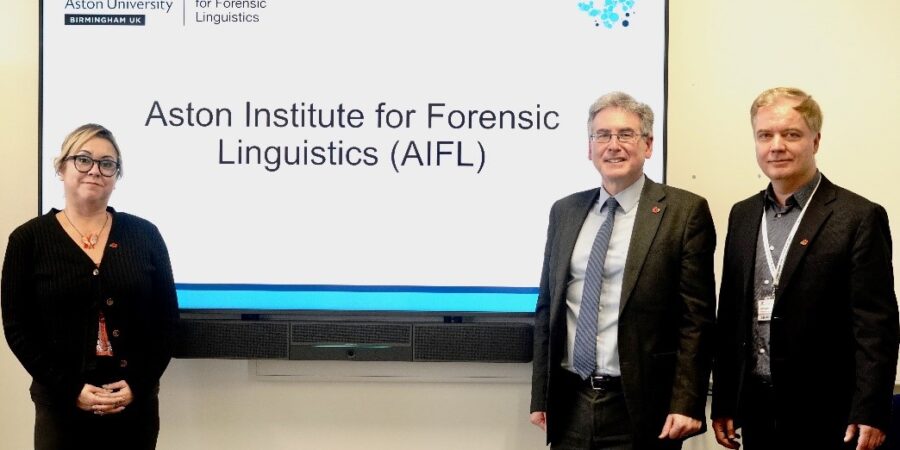
Aston University’s groundbreaking forensic linguistic team welcomed the West Midlands Police and Crime Commissioner Simon Foster to its city centre campus in a special meeting to look at ways of future working.
During the recent visit, Mr Foster spoke with members of the Aston Institute of Forensic Linguistics (AIFL) team in Birmingham City Centre.
Mr Foster heard about the role of the team which is a world-leading hub for forensic linguistics. The discussion looked at ways the team could work more closely with West Midlands Police in research and evidential capacities, as well as outlining some of the previous work that has been delivered with other police forces across the country.
Set up in 2008 (originally as the Centre for Forensic Linguistics), the Institute underwent major expansion with investment from Research England in 2019 and now has more than 40 members, from PhD students to professors.
AIFL conducts cutting-edge research on a broad range of topics that sit at the intersection between language and law, with the common goal being to improve the delivery of justice through the analysis of language.
Current and recent research areas include the stability of an individual’s language style across genres; obstacles to communication in 999 calls; the performance of power in online criminal communities; and the dynamics of interaction in police interviews with victims of rape. All these strands of work lead to tangible benefits for law enforcement, as AIFL researchers strive to build on their findings to inform guidance and training and to improve professional practice.
The Institute also teaches the Aston MA in Forensic Linguistics enabling graduates to secure careers in policing, intelligence analysis and related fields.
Director of Aston Institute for Forensic Linguistics (AIFL), Professor Krzysztof Kredens said: “We’re incredibly grateful to meet with the West Midlands Police Crime Commissioner Simon Foster and it was really productive to discuss future ways of working.
“Our forensic linguistics team here at Aston University is delivering ground-breaking research but we also provide expert advice in criminal and civil cases given our expertise in the field.
“We’re committed to ensuring that the delivery of justice is upheld and the role of forensic linguistics is a vital tool which should be analysed in any form of police work. We’re looking forward to building on this meeting with Mr Foster to find ways to collaborate further in the future.”
Mr Foster added: “It has been great to meet with the team and learn more about the groundbreaking research which is being delivered here at Aston University around the subject of forensic linguistics. As a former solicitor, I found the topic incredibly interesting and it’s certainly something that I’m keen to make sure we can utilise with colleagues here in the West Midlands. There are endless opportunities for us to work closely with Aston University and that is certainly something I will explore with colleagues to ensure we can effectively utilise the resources available.”
During the visit, Mr Foster also met with elected representatives from the Aston Students’ Union to discuss ways of helping students to familiarise themselves with safety advice while studying at the university.
The conversation focused on use of the SafeZone app and positive ways the university can communicate ways to reach the emergency services to help tackle hate crime and violence against women.
Back to News Archive