
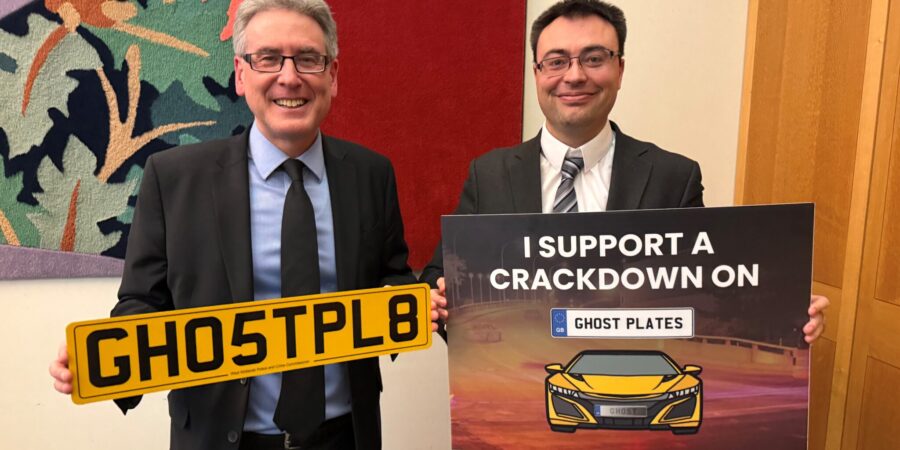
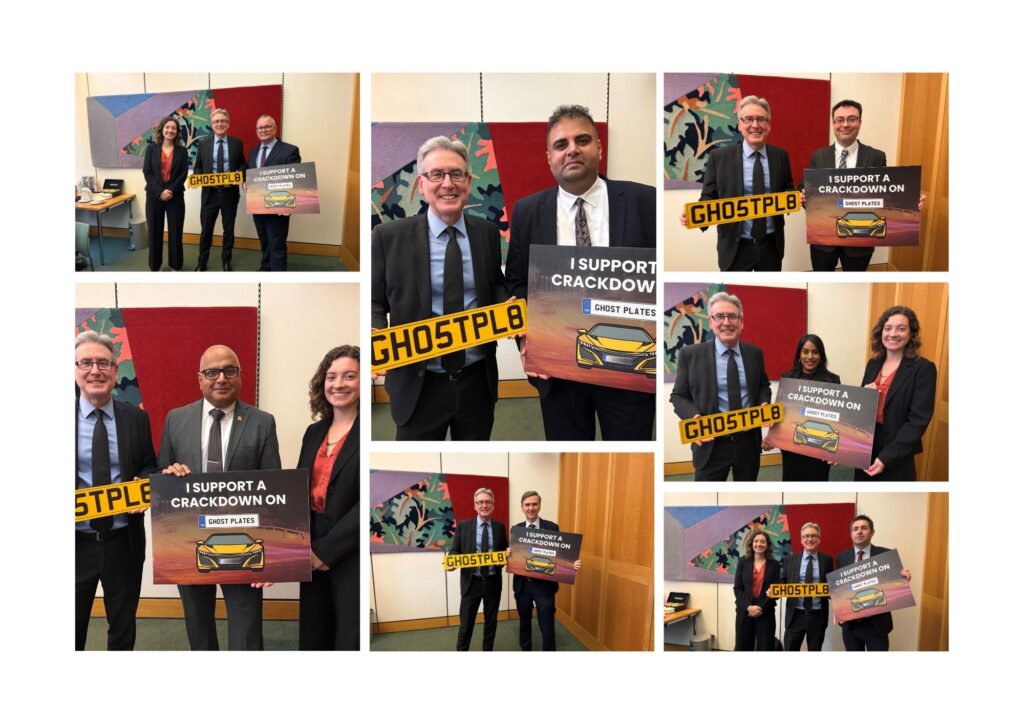
Police and Crime Commissioner Simon Foster welcomed dozens of MPs from across the country to a drop-in event in Westminster to raise awareness of the national threat posed by illegal “ghost plates”.
The briefing, held at Portcullis House today, was jointly organised by West Midlands Police and Crime Commissioner Simon Foster and West Bromwich MP Sarah Coombes. It was shining a spotlight on the number of plates designed to evade Automatic Number Plate Recognition (ANPR) technology.
Ghost plates – typically 3D gel or 4D raised-character plates – appear legitimate to the naked eye, but are unreadable to infrared-based cameras because they use non-compliant, reflective-evading materials.
This enables motorists to avoid detection by police ANPR systems, speed cameras, and other enforcement tools, providing a loophole exploited by offenders across the UK.
New evidence gathered by West Midlands Police during Operation Phantom, in partnership with RedSpeed International, revealed the scale of the problem. Over just six weeks, on a single road in Birmingham between 5am and 8pm:
- 8,403 reads of ghost plates were captured
- 1,884 individual vehicles were identified as displaying ghost plates
- 1 in 237 ANPR reads involved a ghost plate
- 1 in 201 vehicles had a ghost plate fitted
This means that a vehicle displaying an illegal ghost plate passes every nine minutes on an average road in Birmingham.
Simon Foster, West Midlands Police and Crime Commissioner, said: “Ghost plates are a real threat and one we understand an increasing amount about.
“They undermine the rule of law, put communities at risk and allow offenders to operate with impunity.
“The evidence from Operation Phantom is clear: without urgent action, these illegal plates will continue to erode road safety and hinder the police’s ability to protect the public. I am calling on MPs from all parties to join our campaign to tackle ghost plates.”
Because ghost plates render a vehicle unidentifiable to enforcement cameras, they present significant risks to road safety, community safety and national security.
They allow individuals to:
- evade speeding fines and other road enforcement
- avoid identification following collisions
- undermine police investigations and deny justice to victims
- carry out serious and organised crime undetected
Sarah Coombes, Member of Parliament for West Bromwich, added: “This issue is no longer confined to the West Midlands – it is a national problem requiring national action.
“Ghost plates make it easier for criminals to avoid detection and harder for victims to secure justice. I urge colleagues from across Parliament to attend this important drop-in session to discuss how we can work together to close the gaps in regulation and enforcement.”
The PCC and Sarah Coombes MP are urging MPs to support a series of reforms designed to tackle the problem:
- Support a ban on 3D and 4D plates.
- Increase the fixed penalty for number plate offences from £100 to £1,000.
- Make number-plate offences endorsable with up to six licence points.
- Tighten regulation of number plate suppliers through background checks, higher registration fees and regular compliance inspections.
